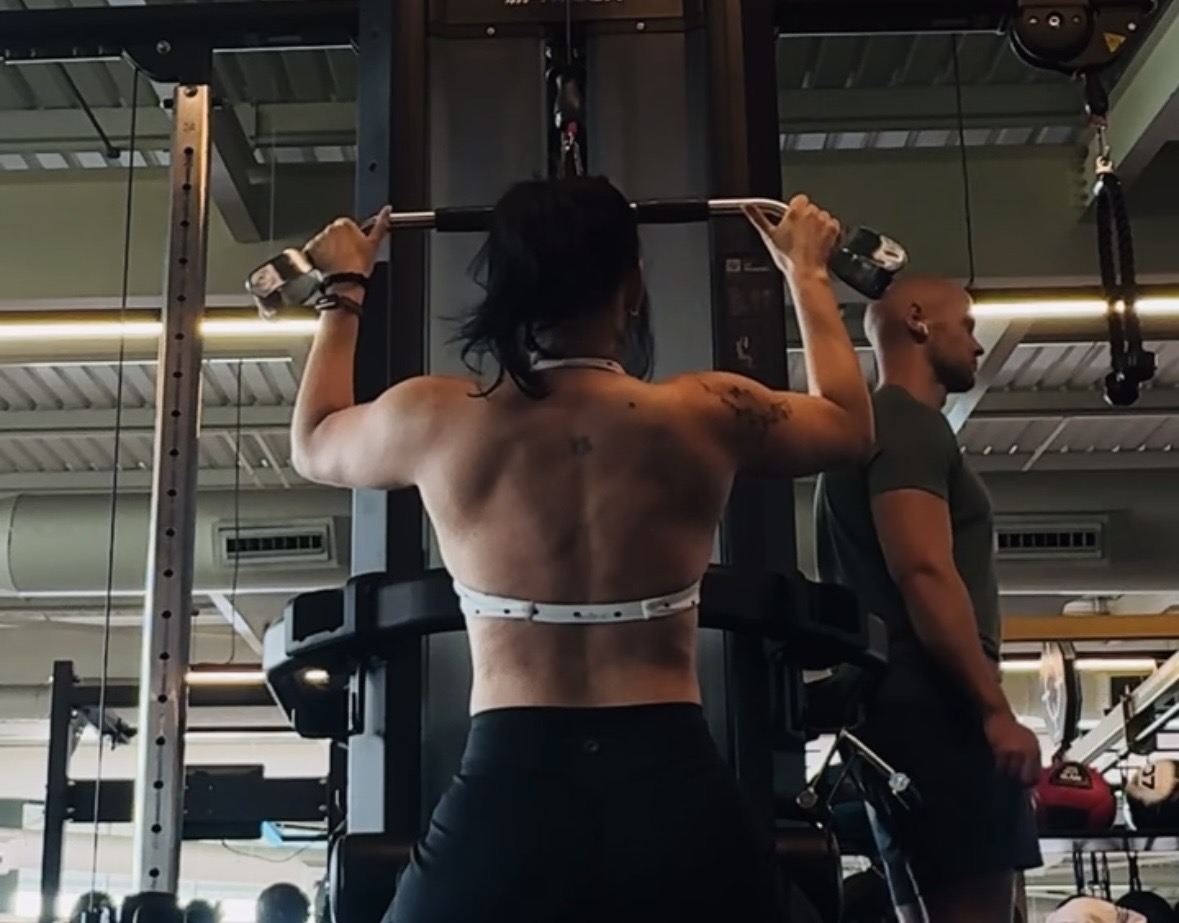
Since my hip replacement and the final stage of my weight loss, I have started receiving a lot more 🔥 emojis and comments on Instagram from both men and women, often expressing surprise at how much my body has changed. But this transformation did not begin with my hip replacement, and it certainly did not begin with the photographs people see now. It started years ago, during lockdown.
The physical transformation is the most visible part, but it is not the part that carries the most meaning for me. Beneath it is a much bigger transformation: how I changed my relationship with movement, solitude, relationships, strength, discipline and ultimately my own life.
The weight loss is simply the part people can see. The person I became along the way is the part that matters most to me.
Why did I gain weight?
Before moving to Europe, I was very skinny. Not lean. Not strong. Just skinny. I’m 170 cm tall, and for years my weight fluctuated somewhere between 49 and 55 kg. I had very little muscle and, like many Brazilian women of my generation, I had grown up surrounded by the idea that being as small as possible was somehow desirable.
Moving to Europe gradually changed that. I started letting go of some of that obsession with being extremely thin. I allowed myself to enjoy food more. I became less concerned about maintaining a particular number on the scale. When I started building my life in the UK, particularly between 2017 and 2019, life became much more social. There were friendships, nights out, relationships, crushes, disappointments and all the emotional ups and downs that came with them.
A lot of those relationships had initially started because somebody found me attractive. Then lockdown happened. Strangely enough, I saw it as an opportunity to step away from all of that and focus on myself. It also forced me to confront something I had been postponing for a long time: I simply was not happy with the life I had built in Europe.
For most of my life in Brazil, I had one goal: to find a way to leave the country and build a life somewhere I could feel safe, and have enough freedom to grow as a person. For years, leaving Brazil had felt almost like the destination itself. Once I had achieved it, however, I eventually had to ask myself a much harder question: now what?
I had reached the place I had spent so many years trying to reach, yet I was not happy with my job, I was not particularly fulfilled by my social life, and, most importantly, I felt that my life lacked a deeper sense of purpose. I had spent so much of my life experiencing relationships through the way other people perceived me that suddenly not being seen felt strangely comforting. This was when I started overeating, at one point gaining around seven kilograms a month, until I reached approximately 110 kg in January 2022, a total gain of 45 kg.
Most days consisted of working my full-time job from home and spending enormous amounts of time alone with my thoughts. As strange as it sounds now, I was happy to have become invisible to most men. And although physically that period was probably one of the least healthy times of my life, psychologically something interesting was happening.
I started learning who I was when nobody else was around. I realised I was an introvert. I realised how much I genuinely enjoyed my own company. I spent hours in my room reading, thinking and questioning what actually made life meaningful to me when relationships were removed from the equation.
There was something valuable in that solitude. But there was also a cost. Towards the end of lockdown, I realised that the little bubble I had created had become far too comfortable. I had started avoiding friends. I avoided speaking to family. Social interaction increasingly felt like something I had to prepare myself for rather than something that happened naturally. After so much isolation, I had developed a degree of social anxiety.
My physical conditioning had deteriorated even more dramatically. Taking the rubbish downstairs felt like a heavy workout. Eventually I understood that, whether I felt ready or not, normal life was going to return. And I needed to prepare my body for it.
The initial changes
Without the usual distractions of commuting, socialising and dating, I decided to start a law degree with the Open University and learn to lift weights in February 2022. By then, I had stopped relying on takeaways and started batch cooking my meals instead.
At the beginning, simply getting to the gym was difficult. The walk from my flat took around fifteen minutes, but even that relatively short distance caused problems. I developed plantar fasciitis and shin splints from ordinary walking because my body had become so poorly conditioned. Everything felt harder than it should have. But I kept going.
Initially, I trained three times a week, and there was nothing glamorous about those sessions. Eventually, going to the gym stopped feeling like an expedition. It became something I loved.
Around the same time, through my law degree with the Open University, I met the man who would become my boyfriend. I was around 92 kg when we started dating. He was eleven years younger than me, jacked, and had been lifting weights since he was a teenager. At the time, however, he was injured and had stopped training because of shoulder pain.
As I became more consistent with my own workouts and learned how to lift properly, he felt motivated to start training again too. Soon, we were working out together. I was discovering strength for the first time, while he was finding his way back to something he had loved for years.
What attracted me to him had little to do with his physique. He was low-profile, humble and down-to-earth. In August 2022, I moved to Glasgow, where life revolved around training, studying, family time and a job I genuinely enjoyed. By October 2023, I had ended the relationship, moved back to Edinburgh and reached 77 kg, 33 kg down from my highest weight.
Hip problems and strength training focus
When I moved back to Edinburgh, I already knew I had osteoarthritis and a labral tear in my left hip, and the pain was becoming increasingly difficult to manage. I returned in the middle of winter, started a new job, and needed time to settle before finding a gym that worked for me.
By April 2024, I was strength training five to six times a week. At that stage, my goal was not fat loss but muscle gain while I figured out whether conservative treatment would be enough for my hip or whether surgery would eventually become necessary. Between training, studying and working full time, I had little energy left for cardio or a calorie deficit, so I focused entirely on strength.
Between April 2024 and November 2025, my weight fluctuated between 77 and 82 kg, but I could see noticeably more muscle definition in both my upper and lower body. A steroid injection into my hip later gave me enough pain relief to start boxing in January 2026.
How boxing is contributing
Between January and May 2026, most of my boxing was one-to-one technique work, as my hip could not tolerate much impact or conditioning. I did, however, improve my endurance with 45 minutes of stationary cycling most days until my hip replacement surgery in May 2026. Looking back, I believe choosing weight training as my main fitness goal was one of the best decisions I could have made, both for my health and aesthetically. It helped me preserve and build the muscle I will need for the rest of my life, including through a major surgery and recovery, while also reducing some of the skin softness that can come with significant weight loss.
Throughout my weight-loss journey, I have also prioritised two simple things: around hight protein intake (between 170 g and 200g of protein a day), 10g of creatine a day, and at least seven hours of sleep. For me, those have been two of the most important foundations for losing weight while maintaining strength and muscle.
From May to July 2026, I focused on body recomposition, eating around maintenance calories while trying to be as active as possible during my hip replacement recovery. As my mobility improved, I gradually returned to boxing in July, this allowed me to lose 8kg.
My routine now consists of three to four weight-training sessions a week, three or four boxing classes plus one one-to-one session, three weekly Couch to 5K sessions, and around 7,000 steps a day, while continuing to eat approximately 170 g of protein daily. This combination has helped me lose fat while rebuilding strength and preserving muscle. I now weigh between 69 and 71 kg, depending on factors such as creatine intake, water retention, and how often I treat myself to higher-calorie foods.
The physique is only the tip of the iceberg
As you can probably see, my weight loss was never built on shortcuts, extreme restriction, or trying to become as small as possible. My goal was simply to be as healthy, strong and happy as I could while living with a painful hip injury.
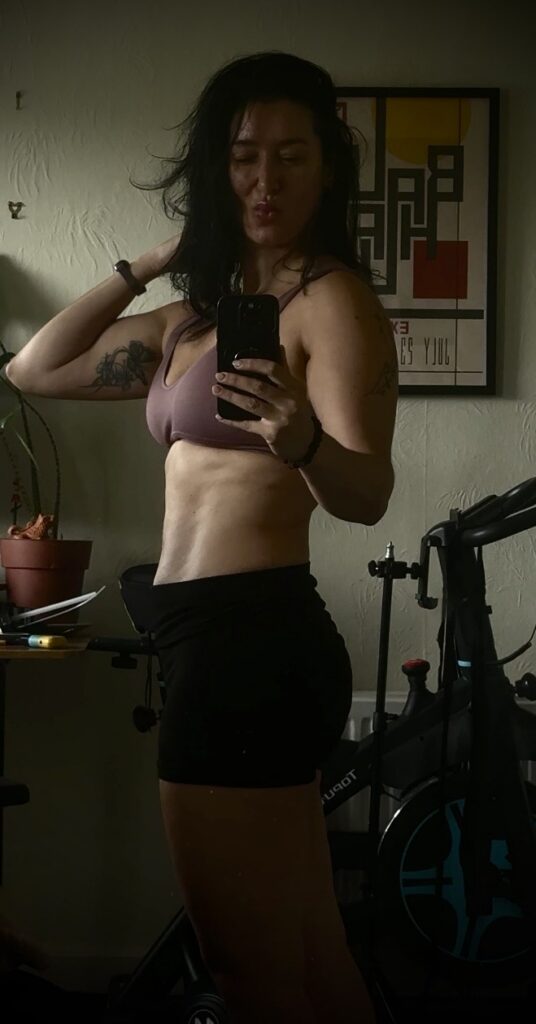
Lockdown also taught me something much deeper. I stopped viewing my body through other people’s eyes. Now, in my forties, I can genuinely say that I enjoy and accept my body for what it is and what it allows me to do. I still train hard, but always with respect for my limitations, and above everything else, my health in mind.
I appreciate every compliment, but the body people see is only a tiny part of the story. We are shaped by years of experiences that influence how we eat, move, cope and treat ourselves. More than any physical transformation, this journey taught me to develop a deep sense of unconditional worth and respect for myself and my body simply as a human being.
I am always genuinely happy to hear that my weight-loss journey has inspired someone to pursue something of their own, whether that means kayaking, building muscle, starting to run, trying Pilates, or simply finding a way to move that suits their body, their goals and their own definition of happiness and success.
My definition of success is feeling happy with who I am as a person, and this has nothing to do with how my body looks, although my body and how I feel reflect my lifestyle and daily choices. This includes the time I go to bed, my thoughts, the people I choose to share my life with, what I eat, and how much I exercise.
But I also hope this story is a reminder that what we see in the mirror is only one small layer of a much bigger human story. The people who choose to become invisible, as I once did, and the bodies we sometimes wish looked different deserve exactly the same respect, compassion and love.
The fittest and most resilient people I know are not necessarily the ones with six-packs or impressive shoulders. They are the ones who can consistently show empathy towards themselves, respect their own limitations, and extend that same respect and compassion to others.