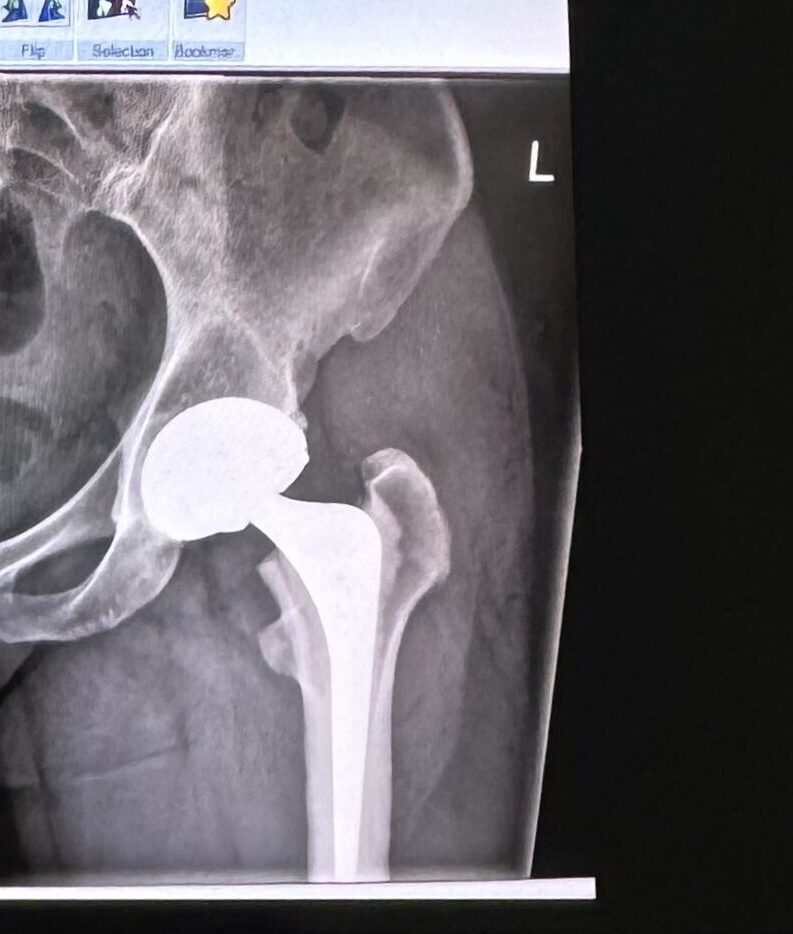
Why a total hip replacement was needed
When I decided to have my left hip replaced at 42, I wasn’t worried about the operation itself. I was worried about what months of inactivity would do to my mental health.
For the previous three years, I’d been lifting weights consistently. Whether it was raining, windy, snowing, or the sun was shining, I crossed the park on my way to the gym. Those walks became part of my routine, and every session gave me something to look forward to.
I was diagnosed with osteoarthritis affecting my spine, from the thoracic region to the sacrum, and hips in 2023 after developing persistent pain in both my upper and lower back. My left hip problems were made worse by a labral tear, which was later accompanied by cam morphology and a significant deformity of the femoral neck. This caused severe pain whenever I sat for more than five minutes or flexed my hip beyond 90 degrees. By the age of 39 I saw myself living with chronic pain, working and most of my lower-body exercises became a form of torture that I had to get used to while I attempted to treat these issues with physiotherapy and strength training. I had zero tolerance for impact, and I would sometimes experience very strong waves of sharp pain while sleeping or when seated.
In November 2025, I experienced significant relief after an arthrogram, that famous corticoid hip injection. This confirmed that the main source of my pain was the hip joint itself rather than the surrounding soft tissues. Over time, the joint degeneration had also led to greater trochanteric pain syndrome, gluteal tendinopathy, and trochanteric bursitis.
My consultant Philip Simpson explained that a hip arthroscopy would involve a longer recovery and was unlikely to solve the problem because of the deformity of the femoral neck and the progressive changes caused by osteoarthritis. We initially scheduled a left total hip replacement for February 2026. However, as I progressed with boxing, I noticed some additional pain relief. I suspect this was partly due to the repeated hip rotation required in boxing, which may have improved joint lubrication and temporarily reduced my symptoms.
The thought of not being able to continue with my boxing training or to lift weights for months, made me deeply sad. I was afraid of losing that routine I loved so much. Movement had become one of the pillars of my mental wellbeing since the end of lockdown, and the possibility of being forced into inactivity felt far more daunting than the operation itself, so I decided to cancel the surgery and leave the idea of a big downtime on hold.
In April 2026, I travelled to London to attend Tyson Fury’s fight and then to Budapest. I had one-to-one boxing sessions that made me want to push myself further in the sport. However, I also knew that the limitations caused by my hip would continue to hold me back. When I returned to Edinburgh, I rescheduled my surgery for 21 May 2026.
Prepping
Boxing was what made me want the surgery as soon as possible. I was ready to leave that chapter of pain and limitations behind for good.
From the moment I returned to Edinburgh, my focus shifted. I treated my recovery like preparing for a fight. I couldn’t control how quickly my body healed, but I could control how well I prepared, how consistent I was with rehabilitation, and the attitude I brought to each day.
I approached recovery with the same discipline I had brought to training. I did a lot of research about rehabilitation, stocked up on HMB powder to support muscle recovery, deep-cleaned my flat, removed furniture that could become a trip hazard, batch-cooked enough meals for the first two weeks, and made sure every practical detail was taken care of before surgery.
I also prepared my corner with the professionals I trusted most: my therapist, Amyas Doulton, who had helped me immensely in 2022 and 2023, and my physiotherapist, the brilliant Riccardo Russo. These are the two guys who have proven to understand how serious I take my fitness life.
The day before Surgery
The first thing I did was request a day of unpaid leave so I could make the most of the day before surgery. I had planned one final boxing session with my second trainer. It was meant to be my way of saying goodbye to boxing, even if only for a while. He agreed but cancelled the day before. I was consumed by disappointment. Then I reminded myself of something I’d learned long before boxing:
I don’t rely on other people to make things happen.
By 7 a.m. I was already up. I walked to The Munro via Water of Leith, then headed back home for breakfast. Afterwards, I spent an hour lifting weights before walking to my old boxing gym to collect the bag I’d left there while training with my first coach. Before I left, he wished me good luck with the surgery.
As I walked out of the gym, I couldn’t hold back the tears. I genuinely believed I wouldn’t be back for at least six months, however another coffee at Patina and my footwork playlist soon dried those tears as I walked across the Gyle to my office to leave my gym bag. I then had that thought again about not having the chance to say goodbye to boxing properly, and once again I caught myself.
“Stop moaning.” “How about those 5 kilometres we kept having to postpone because of your hip? This damn hip will be gone tomorrow, let’s do it!” I looked down at my Fitbit and pressed Start.
The playlist played twice. By the time I stopped jogging, I’d covered 7 kilometres just at the right time to meet my colleague, who also had a hip replacement and head to her place. I returned to the office to collect my things. When I got home, I still wasn’t finished. I completed seven rounds on the heavy bag, followed by 45 minutes on the exercise bike.
That night, I slept like an angel. At 5 a.m. the next morning, I was awake again for one last coffee and one final session on the bike before heading to the hospital.
Looking back, I realise that day wasn’t about squeezing in as much exercise as possible before surgery. It was my way of saying thank you to the body that had carried me through everything, even when it hurt 🥹.
From Surgery Day to the End of Week 1: the most challenging week
My (left) hip replacement was performed on the 21st via AXA at Spire Murrayfield Hospital under an epidural anaesthetic with a low-dose general anaesthetic. Less than three hours later, I was fully awake. Initially, my pain was well controlled with ice, paracetamol, and ibuprofen. A friend visited me that afternoon and was surprised to find me pain-free and already walking around my room using a hospital trolley. However, that changed later that evening. Once the anaesthetic wore off, I experienced the worst pain of my recovery (10 out of 10). I had initially told the nurses I wanted to avoid strong painkillers, but at that point I was more than happy to accept morphine, oxycodone, and co-codamol.
Looking back, my biggest lesson is not to let the pain become so severe that it stops you from moving. Early mobilisation is one of the most important parts of recovery, as modern hip replacements are designed for immediate weight bearing. For some reason I could not sleep for almost 36h, I felt very agitated. Once discharged, I one more episode of severe pain and that was it.
The consultant chose a dual-mobility socket implant because it reduces the risk of dislocation during the explosive pivoting movements involved in boxing. My surgery was performed using the posterior approach. No stabilising muscles (glute minimus & medius / piriformis) or tendons were cut; instead, the glue max was (immensely) split to allow the surgeon to access the hip joint. This is what causes temporary strength and stability loss, and the main reason to take physio / rehab very serious.
The hospital physiotherapist instructed me to perform light activation exercises, which I did four times a day throughout the entire week. I was discharged two days later, stayed with a friend for one night, and then returned home, where I stayed by myself.
Those first few days were uncomfortable but manageable. I was able to walk around the house without crutches, go up and down the stairs to my second-floor flat using crutches, and gradually build up to 10-minute walks, including crossing a busy road to reach the park. I went on these walks every three hours and managed around 4,000 steps a day.
Week 2: going out and building up steps
Building up your step count should be the top priority for anyone recovering from hip replacement surgery. It helps reduce stiffness and the risk of blood clots, supports the recovery of a stable gait, and develops the mobility needed before returning safely to sport.
Neglecting walking during the early stages of recovery may delay your return to sport. It is also a common mistake that can lead to falls and potentially require revision surgery. After all, no one can deadlift properly, run, play tennis or throw a decent hook without adequate balance, stability, and lower-body strength.
Nine days after surgery, I attended a boxing show in Edinburgh using two crutches. I travelled by Uber with my friend Scott, who helped me get in and out of the car safely. On day 11, I had my first physiotherapy session with Riccardo Russo in Stockbridge. I took the tram for the first time, accompanied by a friend, and walked very slowly. I also managed to attend a quiet open jam session in town.
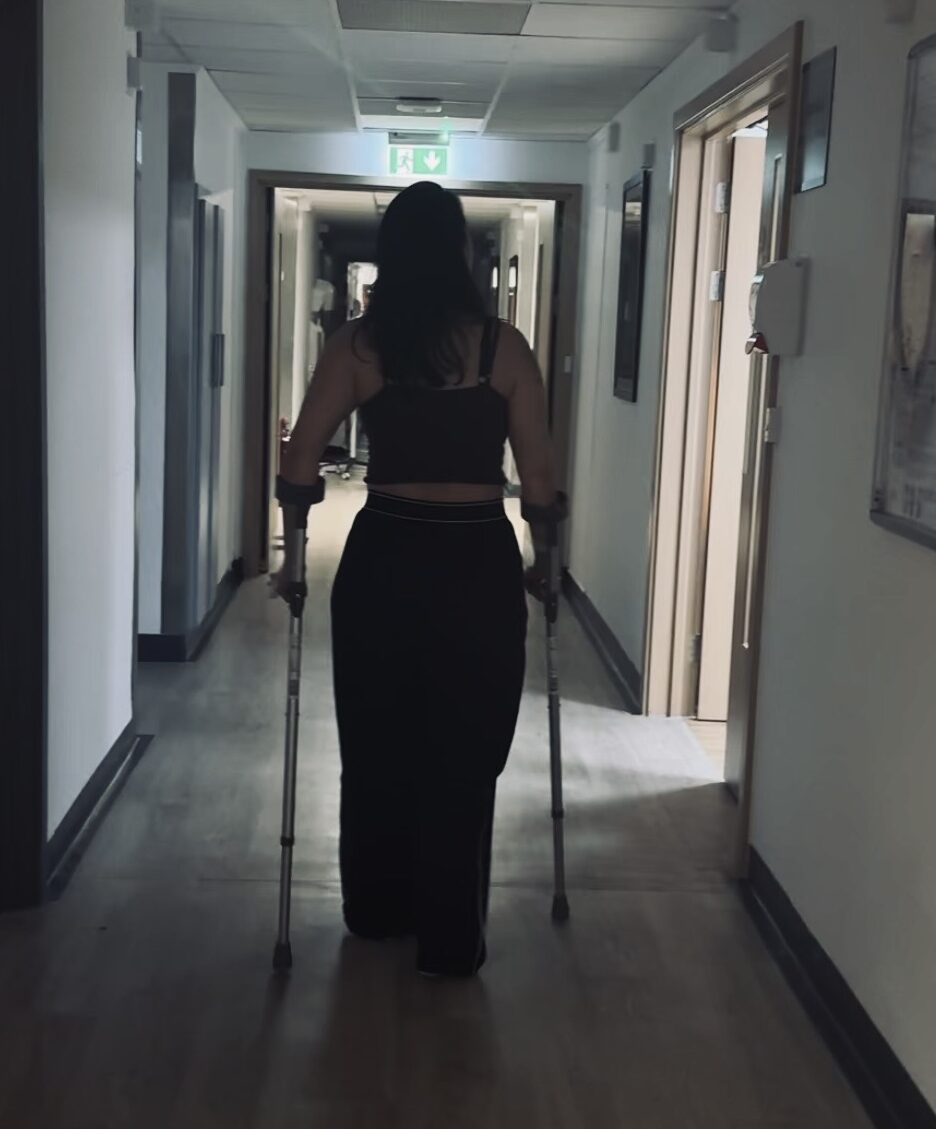
Riccardo immediately encouraged me to walk with just one crutch since our very first session, as he believed I was strong enough to do so. From that day onwards, I felt confident enough to travel by public transport. He also gave me an excellent rehabilitation programme to optimise my strength and stability, which I followed to the letter three times a day for four weeks. I also attempted short distances with no crutch by myself on my daily walks.
Thanks to Riccardo’s guidance and my friend Scott’s support, I was able to take longer walks from the second week onwards. I love being independent and feeling capable of managing my own progress. However, I would have taken a much more conservative approach if I hadn’t had Riccardo encouraging me and reassuring me about my strength, and if I hadn’t had Scott in my corner to carry my belongings and make sure I was comfortable and happy.
By the end of week 4 I could walk 6,000 steps a day with one or two breaks. This was also the week I decided to go crazy and recomp.
How my walk looked like towards the end of week 2
Week 3: back to the gym and my first scape from Edinburgh
By week three, my physiotherapist had cleared me to do any upper-body exercises. As I was also able to walk longer distances safely, I started with two upper-body workouts. Loading the machines was a little challenging, and I noticed that I was still very tired, slow, and weak.
On this week I also went to an open gym session at Coppola Boxing and played a bit with the speed balls and also played my e-drums for the very first time since surgery.
Week three was also when I started noticing some weight loss of around 2 kg. I continued with my walks and gradually built up to 10,000 steps per day, taking as many breaks as I needed. I also completed a slow, uphill walk that lasted around two hours and attended another quiet gig in town.
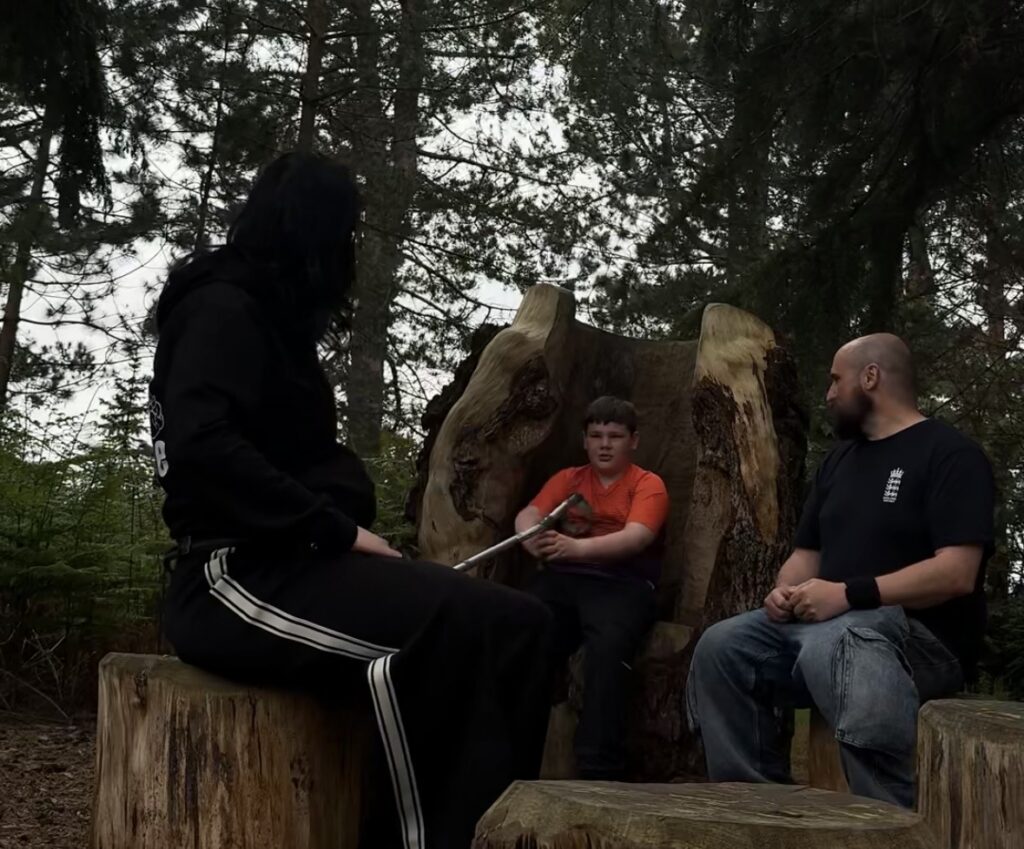
By the end of week three, I travelled to Dundee by train on my own to attend the Lochee ABC show with Scott. Soon after arriving, I left my crutch with Scott’s son, who wanted to pretend he had an injury to fool his mum.
Week 4: Light Stationary Cycling
This week, my physiotherapist cleared me to do some light cycling, but it did not feel great. Limited knee flexion made mounting and dismounting particularly challenging. I also noticed some unusual core compensation while cycling, likely because I was not yet accustomed to the rotational movement required by the dual-mobility hip. It would be a lie to say that I enjoyed it, but I managed to complete three 20-minute sessions. By the end of this week I managed to walk about 15,000 steps per day with one or two breaks.
First cycling session: weird as hell
Week 5: first boxing session & beginning of my personal hell
By week five, I had managed to go out and dance a little, as well as introduce my friend to pad work. A few days later, my orthopaedic consultant cleared me for short flights of up to five hours, light pad work and footwork without explosive rotation, and swimming.
This was when I had my first session with my third trainer in Glasgow, but it was also when my personal hell began, as my birthday was approaching the following week. My mental health was at its lowest because of personal issues with my second trainer, so I booked tickets to Italy to celebrate my birthday.
That trip, together with the boxing session with my new coach, turned out to be one of the best decisions I made and brought life back into my eyes. By this point, I had lost a total of 5 kg, but this was also when I started to feel physically better despite my low mood.
Week 6 & 7: pool rehabilitation
After a night in Naples, I travelled to Capri and began my rehabilitation in the hotel pool. My goal was to improve my range of motion, particularly knee flexion, and introduce some very light impact through pool jogging. I also maintained an average of 15,000 steps a day. While in Capri, I had started doing B-stance Romanian deadlifts with 10kg dumbbells and also tried some bag work, which felt incredibly awkward because of the additional rotation caused by the dual-mobility hip socket.
Towards the end of the week, I travelled to Ischia, where I spent most of my days sleeping about 12h per day between rehabilitation sessions, talking to friends and family on video calls during the day, and finishing chapters two and three of my first book at night.
I also started noticing a worsening of my lower back pain, most likely because I had reduced my daily steps and stopped strength training. At the same time, I felt my mood beginning to improve, and I gradually started planning my return to boxing and how I would build my strength-training routine back up once I returned home. This is when my personal hell ended, all I needed was some time alone, away from my problems in Edinburgh.
Week 8: home-sweet-home
This was my final week off before returning to work, and I wanted to enjoy it as much as possible. The first thing I did when I returned was contact my new trainer, Axel to book our five-session block.
I felt confident enough to resume weight training with three full-body workouts per week. I had no limitations on upper-body training, while for my lower body, I completed a total of 15 sets per muscle group using around 50% of the weight I had lifted before surgery. I also completed week 1 of couch to 5k with no issues and a boxing class with Scott at Shore Boxing.
By the end of the week, I was very stiff because of DOMs, but I was also extremely happy with my overall progress and with the two one-to-one sessions I had completed in Glasgow with my new coach.
Week 8: resuming lower body progressive overload and boxing
Week 9: business as usual
This was when I returned to work and had my first day back in the office. My lower back and hip flexors were still bothering me considerably, so I began prioritising regular core exercises and stretching while continuing with physiotherapy.
I also completed four 45-minute endurance cycling sessions per week, three to four strength-training sessions, three Couch to 5K sessions, and three one-to-one boxing sessions in Glasgow. On my rest days, I resumed using the sauna and doing some very light swimming.
By the end of week nine, I had lost a total of 8 kg.
Week 10: dream life
This was when I finally started to feel like myself again, despite the lower back pain and stiff hip flexors. I would describe myself as something between Frankenstein, a refurbished Rocky Balboa, and a bionic Lara Croft.
I also began to notice the early effects of taking 10 g of creatine daily and following a 170g of protein / 300-calorie surplus. At the same time, I was attending two boxing classes, completing two one-to-one boxing sessions in Glasgow, 3 jogs / couch to 5 K sessions, and four strength-training sessions each week, all while working full-time and studying part-time. Overall, I’m very happy with my new hip and very positive about life, as you can see on this video.
I can only thank everyone who helped make my recovery the best it could possibly be: my friends Mauricio, Scott, and Bia. You were the perfect corner.
I am also incredibly grateful for the professionalism and expertise of my highly skilled surgeon, Philip, my physiotherapist Riccardo, as well as my boxing coach, Axel, who made my return to boxing as smooth and enjoyable as possible.
I would not have done so well without you ❤️.
Keep jabbing, no one cares!